The Visual
Scientist.

______________________________________________________________________________

Scientific Illustrations • Graphical Abstracts • Journal Covers • Data Visualization
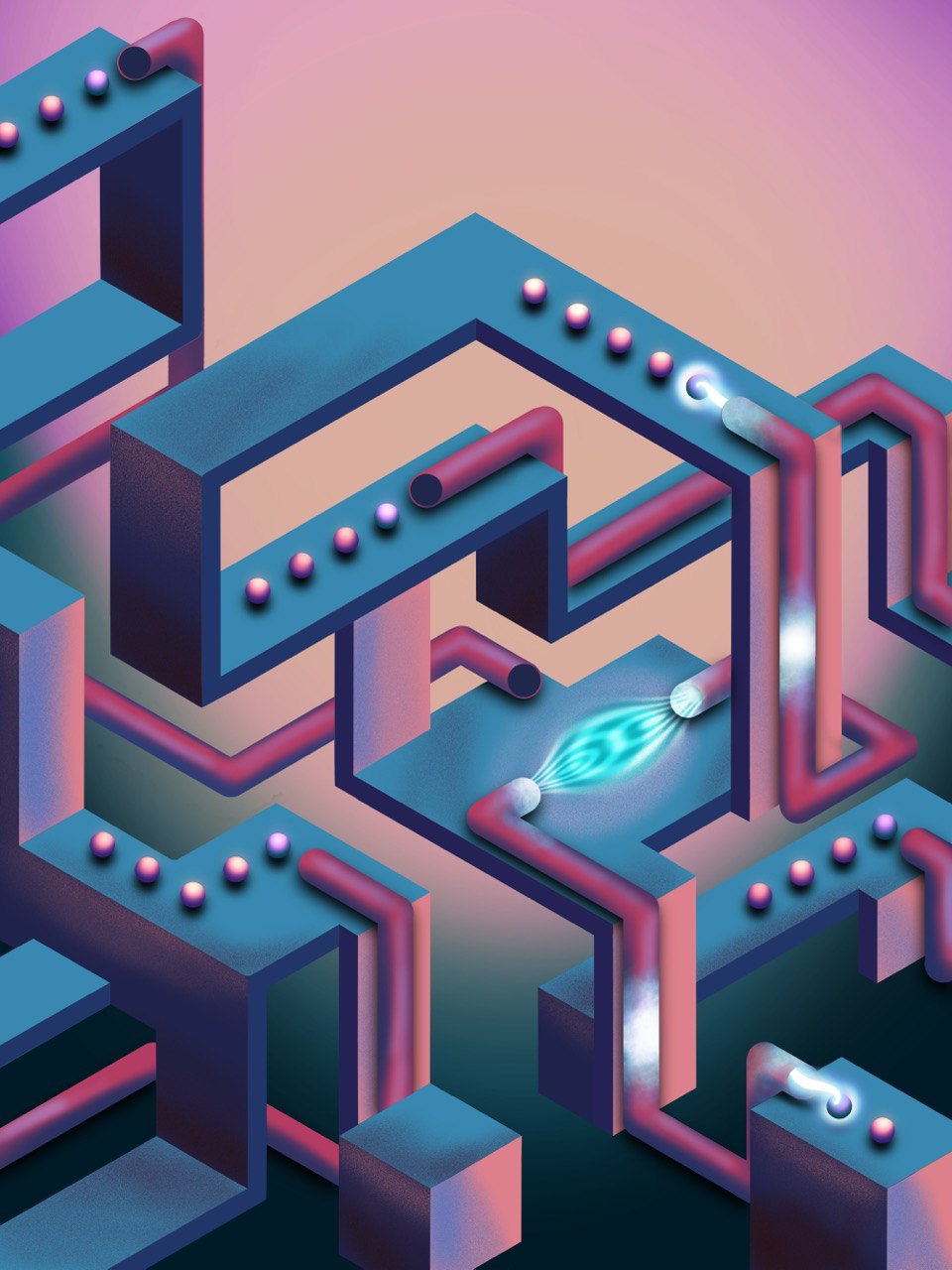
Boltzmann brainHeart transplant Exploring large-scale entanglement in quantum simulation - article published in Nature. The image illustrates a temperature profile determined by the researchers, where “hot” (red) particles interact strongly with the environment whereas “cold” (blue) particles interact weakly with the environment but strongly with each other in the form of entanglement. Verifiable Blind Quantum Computing with Trapped Ions and Single Photons now published in Physical Review Letters. The image illustrates the authors’ secure and scalable approach to cloud-based quantum computing: a user on the right accesses a remote trapped-ion quantum computer in a blind way, which protects confidential data. A quantum link between quantum computer and user is established via single photons sent through an optical fiber. A resulting feedback loop between user and quantum computer allows interactive protocols to be carried out.Researchers from the university of Vienna and QUBO Technology have demonstrated how quantum light can provide security advantages over classical methods in everyday digital payments. The scheme has shown to be robust over an urban optical fiber channel and operates without the need for quantum storage and trusted third parties, marking an important step towards quantum-secure payments with near-term technology.eyeLaser cooling of trapped Calcium ions in a monolithic radiofrequency trap.This illustration portrays the nitrogen cycle, a process in which nitrogen is converted between its various chemical forms, while circulating through the atmosphere and other ecosystems where it is harnessed by living organisms. An international team formed by members from Alpine Quantum Technologies GmbH, QC Ware, Covestro and Boehringer Ingelheim now developed a novel hybrid quantum-classical algorithm for studying one reaction within this cycle on a trapped-ion quantum computer. In particular, they focused on a reduction of NO to N2O, catalyzed by a nitric oxide reductase. This work represents a significant step in the advancement of quantum chemistry calculations on hybrid quantum-classical processors. Macroscopic Quantum Superpositions via Dynamics in a Wide Double-Well Potential - now published in Physical Review Letters. The image illustrates a nano glass bead, initially trapped in an optical tweezer and subsequently propagating through a 1-dimensional dark potential in which its quantum state becomes delocalized, creating a macroscopic quantum superposition.Distributed Quantum Computing across an Optical Network Link, now published in Nature. Researchers at the university of Oxford have for the first time demonstrated distributed quantum computing by interconnecting two trapped-ion quantum computers via a photonic link. More specifically, interfering photons emitted by ions located in different registers allows entangled states between them to be formed, a resource used for quantum gate teleportation. These results mark an important step in the development of scalable quantum computing architecture.Exploring large-scale entanglement in quantum simulation - article published in Nature. The image illustrates a temperature profile determined by the researchers, where “hot” (red) particles interact strongly with the environment whereas “cold” (blue) particles interact weakly with the environment but strongly with each other in the form of entanglement. Quantum correlations within a 91-ion Coulomb crystalIntegrating a quantum computer (QC) into a high performance computing (HPC) environment. Alpine Quantum Technologies has joined efforts with the University of Innsbruck to realize a hybrid HPC-QC infrastructure. This hybrid system constitutes an important milestone in making quantum computing more accessible. At the same time, the connection of these specialized computing units allows optimum solutions for classically challenging computational problems to be implemented.

© 2026 Helene Hainzer
All rights reserved.